It was a tragic end for a former police sergeant.
A 73-year-old woman from Connecticut was found dead in her home after being missing for several months.
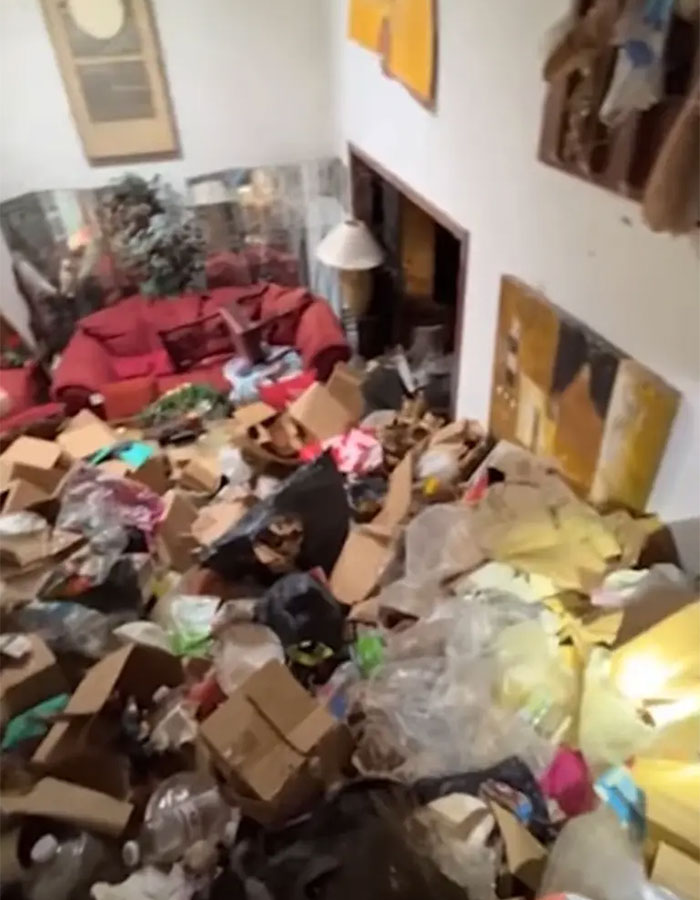
Newly released police photos and videos reveal the home’s shocking conditions, with evidence pointing to severe hoarding disorder that had overtaken her living space.
Police discovered the body of Mary Notarangelo seven months after conducting the initial welfare check.

According to the Associated Press, Mary Notarangelo was a retired police sergeant living in Glastonbury, a town just southeast of Hartford.
She largely kept to herself.
After a friend hadn’t heard from her in over a month, police conducted a welfare check—but found the home so filled with clutter, trash, and bird cages that they could barely move through it.

Police made multiple follow-up attempts to contact Notarangelo, but each effort came up short. It wasn’t until seven months after the initial welfare check that her remains were finally discovered.
Local outlet CT Insider recently obtained photos and video footage from those early police searches—and what they reveal is nothing short of shocking.
Among the disturbing discoveries were moldy cardboard boxes, discarded fast food containers, and rat droppings—painting a grim picture of the conditions inside the home.

It was July 2024 when a concerned friend of Mary Notarangelo contacted local authorities to request a welfare check.
According to the Associated Press, the friend had received a troubling text from Notarangelo in mid-June, in which she mentioned experiencing abdominal cramps, vomiting, and having suffered a fall.
When weeks passed without any further contact, the friend reached out to police on July 3rd—prompting the first attempt by officers to enter the home.

Body cam footage from that day shows officers forcing the door open and climbing over towering piles of debris—some stacked as high as six feet.
The floors were completely covered with rotting food containers, plastic bottles, moldy cardboard, wilted fast food packaging, and rat droppings. The smell was overwhelming.
Footage captured from inside the officers’ hazmat suits reveals the full extent of the squalor. Police described a stench so severe it was difficult to breathe.
Then there were the bird cages—dozens scattered throughout the house. Most were empty, but a few still held the remains of dead birds.
It was immediately clear the home’s former occupant had been battling an extreme case of hoarding disorder.
Hoarding is a condition where a person struggles to part with possessions, and experts warn that it can have serious consequences.

Hoarding is a mental health disorder that, according to experts, can range in severity from mild to life-threatening. In extreme cases, it can lead to dangerously unsanitary and unlivable conditions.
The Mayo Clinic defines hoarding disorder as “an ongoing difficulty discarding or parting with possessions because you believe they need to be saved.”

According to the site, individuals with hoarding disorder often accumulate large amounts of items—many of which have little to no value.
Their homes are frequently described as being in “extremely cramped living conditions,” with only narrow walkways carved through towering piles of clutter.
The clutter inside Notarangelo’s home was so overwhelming that even drones struggled to navigate through the piles of debris.

Police noted that the narrow walkways often seen in severe hoarding cases were absent from Notarangelo’s home, raising questions about how she was able to move through the space at all.
Videos and documents obtained by CT Insider through a Freedom of Information Act request outline the multiple efforts made to locate her.
Following the initial welfare check on July 3, 2024, officers returned to the property on July 5th, 11th, 12th, and again on November 20th of the same year—each time unsuccessful in finding her.

Each time officers returned, the extreme hoarding conditions were cited as major obstacles to the investigation and search efforts.
During at least one visit, the Associated Press reports that drones were deployed inside the house in an attempt to access areas too dangerous or inaccessible for personnel. However, dense cobwebs, thick layers of dust, and unstable piles of debris prevented the drones from making any meaningful progress.
It wasn’t until February of this year that an environmental cleanup crew brought in an excavator to carefully clear out the massive accumulation of refuse. Shortly afterward, police discovered Notarangelo’s skeletal remains buried beneath the wreckage.
She Had a Big Heart for Animals”: Friends Reflect on Notarangelo’s Life
According to the Associated Press, efforts to reach Notarangelo’s brother, niece, and attorney were unsuccessful.
However, a friend and former colleague, Patti Steeves, spoke to the outlet and described Notarangelo as quirky, but ultimately a kind-hearted person.
Steeves shared that Notarangelo was deeply devoted to her work and her spiritual beliefs, particularly Wicca—a pre-Christian, nature-based religion she held close.
“She was passionate about her faith. She was passionate about her job. She had a great sense of humor. And she loved her animals—she loved them more than she loved herself,” Steeves told the Associated Press.
According to the AP, Notarangelo served with the Bridgeport Police Department from 1985 to 1996. She was promoted to detective in 1992 and then to sergeant in 1993.
Steeves said Notarangelo retired on disability following an on-duty car accident that left her with injuries to her back and legs.
Netizens react with shock after getting a glimpse inside the home of someone living with hoarding disorder.