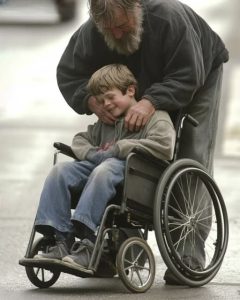
It was an ordinary afternoon in the city square, sunlight filtering through the buildings, footsteps echoing on the pavement, the usual hum of daily life. I sat in my wheelchair, my old flute pressed to my lips, letting the music carry me away from the pain that never left my body.
Fifteen years on the streets had taught me to find solace in small things. The melody was my escape, a fleeting moment of peace from the relentless ache in my bones. Once, I had a different life, a job at a factory, coworkers who felt like family, a future that seemed steady. But then my body began to fail me. The doctors called it degenerative, incurable. The factory let me go. And just like that, I was left with nothing but this wheelchair, a parting gift from my old friends, a cruel reminder of what I’d lost.
That day, as I played, a child’s voice cut through the music.
“Mama, listen! It’s magic!”
I looked up to see a boy, maybe seven or eight, clutched in his mother’s arms, his eyes wide with wonder. His mother’s face was lined with exhaustion, but she smiled at his excitement.
“Can we stay?” the boy begged.
She hesitated. “Just a little longer, Jake. We have to get to your appointment.”
I lowered the flute. “Want to try?” I asked gently.
His smile faded. “I can’t walk,” he whispered. “It hurts too much.”
His mother’s grip tightened. “We can’t afford a wheelchair,” she admitted, her voice hollow. “I carry him everywhere.”
The words hit me like a punch. I knew that kind of struggle, the kind that wears you down until you forget what hope feels like. But in Jake’s eyes, I saw something I hadn’t felt in years, a spark, a longing for something better.
Before I could second-guess myself, I gripped the arms of my chair and forced myself to stand. Pain shot through me, sharp and unrelenting, but I ignored it. “Take it,” I said, nodding at the wheelchair. “I don’t need it as much as he does.”
The woman’s hands flew to her mouth. “We can’t—”
“Please,” I insisted.
Tears spilled down her cheeks as she settled Jake into the chair. The way his face lit up, like he’d been given the whole world, made the pain in my legs feel insignificant.
“Thank you,” she whispered, her voice breaking.
I just smiled. “Go on.”
As they disappeared into the crowd, I leaned heavily on my cane, every step agony. But for the first time in years, my heart felt light.
Years Later
Time passed. My body grew weaker, but I still played my flute in the square, clinging to the memory of that day. Then, one afternoon, a shadow fell over me.
“Remember me?”
I looked up, and froze. A young man stood before me, tall and steady on his feet. His grin was familiar.
“Jake?” My voice cracked.
He laughed. “Took you long enough.”
I stared, stunned. “You’re… walking?”
“Turns out my condition wasn’t as bad as we thought,” he said, sitting beside me. “After you gave us the wheelchair, things changed. An old relative left us some money. Got the right treatment. And my mom? She runs her own bakery now.”
He handed me a slender case. Inside was a beautiful new flute, and beneath it, a stack of bills and a note:
*”For the pain you endured to give me a chance. Thank you for showing us that kindness still exists.”*
My hands shook. This wasn’t just money. It was a second chance.
Jake squeezed my shoulder. “You saved us,” he said softly.
As I watched him walk away, I realized something: kindness isn’t just about giving. Sometimes, it comes back to you when you least expect it.
And that, that is the real miracle.