He barely spoke during the drive. Just stared out the window, fingers resting on the armrest like they were holding onto something invisible. I asked him a few things, soft, cautious questions about the old farm, what he thought he’d find, but he only gave a faint smile. The kind you wear when your heart’s too full of memories to speak.
We hadn’t known each other long. Nathan Boyd was my biological father, but we’d only connected a few months ago. I was 24 when a casual DNA test at a family barbecue blew my world wide open. What followed was a string of hushed conversations, shattered truths, and eventually, a name scribbled on the back of a faded receipt: Nathan Boyd.
I called twice. The first time I hung up. The second time, he answered with a cautious “Yeah?” that sounded like a dare.
And now here we were.
The second we turned onto the gravel road, his whole demeanor shifted. He sat up straighter, jaw clenched, shoulders tense. When the barn came into view, worn but still standing, he whispered, “Stop here.” First words in half an hour.
I pulled over. He stepped out before the truck even came to a full stop. He stood still, breathing in the place like he was trying to remember who he used to be.
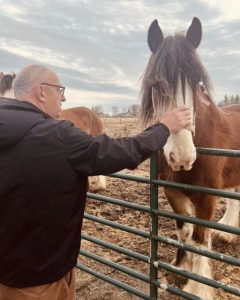
A few horses grazed in the field beyond. One, massive, with a rough black mane and legs feathered like a Clydesdale, lifted her head and started walking toward him.
He didn’t move. Just extended a trembling hand.
“She was a foal when I left,” he said. “There’s no way she remembers me.”
But the horse pressed her nose into his palm like she’d been waiting for him.
He choked on his next words. “I named her after your mom.”
My breath caught.
He didn’t mean the woman who raised me. He meant her. The woman I only knew through a grainy photo and a death certificate. My mother, the one who died just after I was born.
“You left,” I said slowly, “after she died.”
He nodded, still gently petting the horse. “I couldn’t do it. I couldn’t look at you without seeing her. I broke. So I ran.”
I’d spent my whole life thinking he walked away because he didn’t want to be a dad. But this… this wasn’t abandonment. It was grief too big to carry.
“She died because of me,” he whispered.
I turned. “What?”
He stared ahead. “Pregnancy complications. The doctor warned us. Said we should’ve waited. But we were so happy. Then it all went wrong. I held her hand until she went still.”
Silence settled between us, heavy but honest. The wind moved through the tall grass, carrying the smell of hay and something older than time.
“She would’ve loved you,” he said. “You have her eyes.”
We stood there a while, not saying much, as the horse, Maggie, nuzzled his chest like she understood.
He smiled sadly. “She used to run barefoot across this field. Hair flying. Arms wide open like she was hugging the sky.”
Then he looked at me. “I don’t expect anything. Not forgiveness. Not time. But thank you for bringing me here. I needed to see it again.”
“What do you mean?”
“It’s being sold. Developers. My cousin inherited the land after I disappeared. This is probably the last summer these fields will ever be fields.”
I felt a strange ache. I didn’t grow up here, but somehow, it already felt like something I was about to lose.
“Unless…” He trailed off.
“Unless what?”
He sighed. “There’s a clause. Someone in the family can still claim it. But I’m not family anymore. I gave up my rights a long time ago.”
I didn’t say anything then. But that night, back in my apartment, I couldn’t stop thinking about it. The photo of my mom. The old deed. The news clipping about the Boyd Farm from 1997. All of it sat on my kitchen table, daring me to make a decision.
Two weeks later, I did.
It took a handful of lawyers and one tense brunch with Nathan’s cousin, but we made it happen. Turns out the clause had some wiggle room, especially if I wanted the land. And I did.
Not because I knew how to run a farm.
Not because I had dreams of rural life.
But because this place was where I started. Because healing sometimes looks like returning to the beginning.
Nathan and I started coming back every weekend. He taught me how to saddle a horse. How to walk through tall grass without spooking anything. How to listen to the wind.
We didn’t talk much about the lost years. But we talked. And for the first time, that was enough.
Sometimes, when the light turned gold and the barn groaned like it was remembering something, Maggie would find him again. Nudge his shoulder. Make sure he was still here.
And he always was.
If this story touched something in you, share it. Like it. Because somewhere out there, someone might need to be reminded: it’s never too late to go home.