I thought I understood what silence meant. Growing up with my brother Keane taught me that it could speak volumes. He never really talked, not with words. Instead, he communicated through tiny details: the way he lined up his pencils, how his eyes tracked the ceiling fan, how his jaw would clench just slightly when something felt off. We adapted to his quiet world. Or maybe we just learned how to survive in it.
Keane was diagnosed with autism at three. I was six. I don’t remember the exact day the word entered our lives, but I remember how things shifted. Our home grew heavy with hush. Mom seemed tired all the time. Dad got irritated over things like crinkling wrappers or the clatter of silverware. I learned to stay small and out of the way. And Keane? He stayed kind. Distant. Always smiling, but never at people. He never said a word.
Years later, after we lost both our parents, Dad to a stroke, Mom to cancer, I brought Keane to live with me. The state home had pulled him further inward, and I couldn’t leave him there. He didn’t respond when I asked if he wanted to move in. He just quietly packed his things.
That was six months ago, right before my son Owen was born. Since then, Keane had been living in our home, folding laundry with crisp corners, playing puzzle games on his tablet, humming softly and constantly. He still never spoke. Not even once.
Until one ordinary Tuesday morning.
Owen had been up all night teething, and I was barely holding it together. My husband was working back-to-back hospital shifts, and I was running on fumes. After finally putting Owen down for a nap, I dashed into the shower, desperate for ten minutes of quiet.
That’s when I heard it, Owen’s scream. Not just crying, but the kind of cry that makes your heart seize. I ran out, shampoo still in my hair, soaking wet and terrified.
And then I stopped.
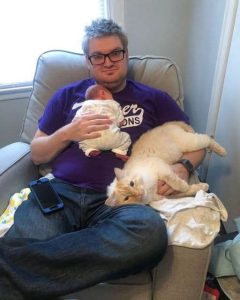
Keane was sitting in my armchair, his first time ever using it, with Owen curled peacefully against his chest. He was gently rubbing Owen’s back in long, slow strokes. Owen had fallen asleep, completely calm. And Keane? He looked up and said:
“He likes the humming.”
My knees almost gave out.
It was his voice. Real. Clear. Soft. And full of love.
He repeated it again. “He likes the humming. Like the app. The yellow one. With the bees.”
I knelt down beside him. “The lullaby app?” I asked.
He nodded.
That was the beginning of everything changing.
That day, I let Keane hold Owen for as long as he wanted. The baby slept soundly in his arms. And Keane didn’t flinch under the attention like he used to. He stayed grounded. Present.
From then on, he started participating more. He fed Owen. Changed diapers. Gave little insights that stunned me:
“He doesn’t like the green wipes. Too cold.”
“The red bottle leaks.”
“The heater makes Mango grumpy.”
He was noticing, connecting, communicating. Bit by bit, the silence cracked open.
One night, my husband whispered, “It’s like he’s waking up. Like we’re finally meeting him.”
And yet, even with all the awe and gratitude, I felt guilt creep in. Because for all those years, I hadn’t seen him. I thought I was helping by not asking more, by staying in his comfort zone. But maybe I was just afraid of pushing, afraid of breaking something that was never broken to begin with.
Then came a night that nearly shattered me.
I came home from a late Target run to find Keane pacing anxiously. Mango, our cat, scratched at Owen’s door. From inside, I heard crying.
Keane looked at me with wide, panicked eyes.
“I dropped him,” he said.
I froze.
“In the crib,” he added quickly. “I misjudged. I was trying to be quiet. He hit the side. I’m sorry.”
I rushed in. Owen was fine, just cranky from being disturbed. Nothing serious.
When I came back, Keane was sitting silently on the couch, whispering, “I ruined it. I ruined it.”
I sat next to him.
“You didn’t ruin anything,” I said.
“I hurt him,” he whispered.
“You didn’t. You made a mistake. We all do.”
He stared at me, trembling.
“You’re not broken,” I told him softly. “You never were. I just didn’t know how to listen.”
He broke down. I held him. And in that moment, I finally understood love, not as something loud or heroic, but as the quiet act of fully seeing someone for who they are.
Now, six months later, Keane volunteers at a sensory play center twice a week. Owen adores him. His first word wasn’t “Mama” or “Dada.”
It was “Keen.”
I never thought a whisper could change everything.
But it did.
“He likes the humming.”
And just like that, my brother found his voice. Not in words alone, but in presence, in love, and in the power of being truly heard.
Because sometimes, the softest voices are the ones that echo the loudest.