
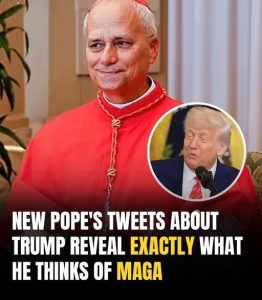
Despite being born in Chicago, newly elected Pope Leo XIV has long voiced opposition to former President Donald Trump’s immigration policies, statements that have resurfaced in light of his election as the 267th pope.
Formerly known as Cardinal Robert Prevost, the 69-year-old Augustinian missionary was elected Thursday, becoming the first American-born pope and spiritual leader to over 1.4 billion Catholics worldwide. While the U.S. has long held global secular power, the Vatican traditionally avoided choosing an American pope due to political optics, making Leo’s ascension historic and surprising.
But while Leo is American by birth, he is also a naturalized Peruvian citizen who spent decades in Latin America. He speaks both Spanish and Italian fluently, which he used to deliver his first public remarks as pope. He has rarely spoken in English on the world stage, a symbolic distance from American political alignment.
And that distance is clear in his documented criticism of U.S. immigration policies under Trump, especially as they relate to the treatment of undocumented families and migrants.
In one of his final tweets as Cardinal Prevost, shared April 14, he reposted a message condemning the deportation of Kilmar Abrego Garcia, a 30-year-old undocumented father of three from Maryland, who was mistakenly deported to El Salvador under the Trump administration. “Do you not see the suffering? Is your conscience not disturbed? How can you stay quiet?” the post read.
Prevost has also openly pushed back against Vice President JD Vance. He once reposted a scathing article titled “JD Vance is Wrong: Jesus Doesn’t Ask Us to Rank Our Love for Others,” criticizing Vance’s interpretation of Christian moral priorities in immigration policy.
As early as 2017, Prevost showed public support for DACA recipients, undocumented immigrants brought to the U.S. as children. In 2018, he posted:
“There is nothing remotely Christian, American, or morally defensible about a policy that takes children away from their parents and warehouses them in cages. This is being carried out in our name, and the shame is on us all.”
He also shared a letter from Peru’s Catholic bishops thanking the Trump administration for halting family separations but highlighting how Latin American nations like Peru have taken in thousands of Venezuelan migrants fleeing crisis, without resorting to inhumane treatment.
Given his years living and serving in Peru, his views on immigration reflect not just theological compassion but lived experience. Colleagues describe him as “the least American of the Americans”, a tennis-loving cleric with a reformist streak who is expected to continue Pope Francis’ legacy.
Leo was elected quickly, on the second day of the conclave. Crowds in St. Peter’s Square erupted in cheers as white smoke rose above the Sistine Chapel. When his name was announced, some in the crowd were audibly surprised, whispering, “An American?” and chanting “Leon! Leon!”
While Leo has remained quiet on hot-button Church issues like same-sex relationships and female clergy, his track record shows clear commitment to Catholic social justice, especially on migration, poverty, and compassion for the marginalized.
Nevertheless, both Trump and Vance issued congratulatory statements following his election.
“Congratulations to Cardinal Robert Francis Prevost, who was just named Pope,” Trump wrote. “It is such an honor… What excitement, and what a Great Honor for our Country.”
Vance added: “I’m sure millions of American Catholics and other Christians will pray for his successful work leading the Church. May God bless him!”
Prevost was twice elected prior general of the Augustinian Order, one of the oldest religious orders in the Church, and was later sent to Peru as an archbishop. He was elevated by Pope Francis to top Vatican roles before being chosen as his successor.
Dressed in the traditional crimson papal cape, a symbolic choice Pope Francis rejected in 2013, Leo XIV delivered his first blessing with a focus on peace and missionary outreach.
He now carries the same papal name as Leo XIII, a reform-minded pope who redefined the Church’s stance on modern economics and workers’ rights in the late 19th century. That legacy of social concern may echo through the decisions of the new Pope Leo, especially as his past suggests a clear moral stance on the politics of compassion.

