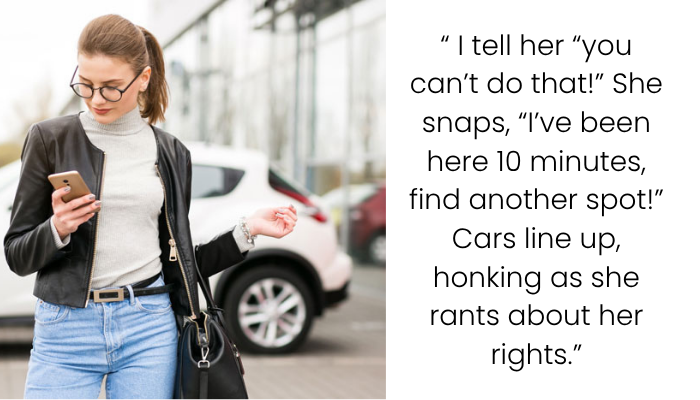
The original poster tried to park in a mall lot, but a woman was blocking the space to “save” it for her husband and she wouldn’t move, even after a security guard intervened.
A Parking Lot Showdown That Says a Lot About Entitlement
While undeniably amusing, this parking lot standoff highlights a deeper issue: how public spaces become battlegrounds for control and how entitlement shows up in everyday life. Parking lots especially on busy days are pressure cookers where unwritten rules of fairness and patience are constantly put to the test.
Can You Legally “Save” a Parking Spot on Foot?
Legally speaking, standing in a parking space to hold it for someone else isn’t typically recognized or enforced. There’s no blanket law banning it, but both local authorities and private security like mall enforcement generally side with the driver who arrives in a car, not the one claiming the space on foot. Malls are private property, so their own policies apply, and in this case, security did exactly what they’re there for: clearing an obstruction and keeping order.
In fact, in some areas, this kind of behavior could be considered a public nuisance or even obstruction, especially if it causes traffic backups or confrontations. According to organizations like AAA, reserving spots this way is not only unfair it’s unsafe and often a trigger for unnecessary conflict.
The Psychology Behind Entitled Behavior
The woman’s behavior in this story is a textbook example of entitlement in action. Psychologists often link this to “egocentric bias,” where someone places their own needs above everyone else’s, especially in shared spaces. Blocking a spot for several minutes while causing frustration to other drivers shows a clear disregard for social norms and basic situational awareness.
Entitlement tends to grow stronger when challenged publicly. Instead of backing down, the woman doubled down using her husband’s supposed high-status job as justification for her behavior. That’s a classic case of status signaling, where people invoke power or privilege (real or imagined) to try and avoid consequences.
The Power of Social Norms and Public Pushback
Parking lot etiquette runs on unspoken agreements: take turns, don’t double park, don’t block others. When someone breaks these informal rules, especially in a high-stress setting like a packed mall lot, it doesn’t just annoy people it triggers a sense of collective frustration. The honking drivers weren’t just impatient; they were signaling social disapproval.
This scenario also shows what social psychologists call diffusion of enforcement, when one person (like the narrator) steps up, it encourages others to support that action, whether through honks, comments, or just staying silent in solidarity. And when formal authority shows up, like mall security, it gives the situation structure and helps defuse conflict without chaos.
The Twist Ending That Says It All
Of course, the cherry on top was the final line, when the woman’s husband arrives and casually announces, “Karen, I parked over there!” It’s not just funny, it’s a moment of poetic justice. Her excuse crumbles, her defiance becomes unnecessary, and the public embarrassment does more to curb her behavior than any argument could.
Relatable and All Too Common
After the story went viral, people flooded the comments with similar tales of dealing with entitled individuals in parking lots and other shared spaces. Apparently, this kind of behavior strikes a nerve because so many of us have seen it before.