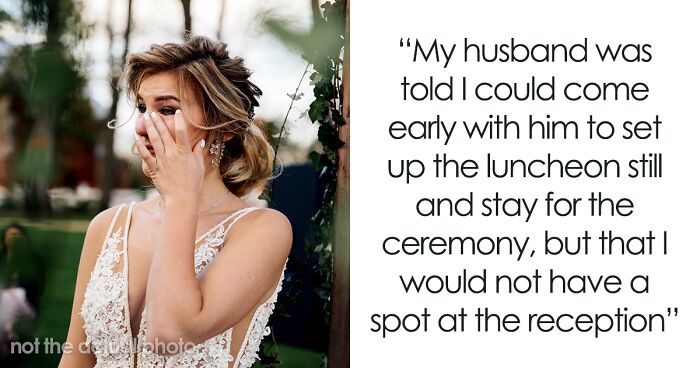
Beneath the surface of seating charts and flower arrangements, wedding planning can sometimes reveal hidden resentments and longstanding tensions.
That was exactly the case for today’s Original Poster (OP), who shared her story of being left out of her brother-in-law’s wedding reception—even though she’s married to the best man, is the mother of the ring bearer, and helped organize the bridal luncheon.
It’s one thing to be overlooked by strangers—but it hits differently when the people who should know and value us most are the ones who make us feel invisible.

As soon as they received the brother-in-law’s wedding invitation, the author and her husband promptly RSVP’d for themselves and their 4-year-old son.


She was also helping plan the bridal luncheon and offering vendor contacts, so she assumed she was fully included


Later, the bride claimed they never RSVP’d and said that only the husband and son had seats reserved at the reception.


The author was then told she could help set up and attend the ceremony, but not stay for the reception


She felt hurt and used, uncertain whether it was an honest oversight or a deliberate slight—especially since there had been no prior conflict.


Her husband chose to speak directly with his brother, while she considered whether to involve her mother-in-law.


After reaching out to her mother-in-law, the groom attempted to log into the wedding website to check the RSVP but found he couldn’t access the site.


When he asked the bride for the password, she dodged the question and told him to come home instead.


The bride then offered several conflicting excuses and dismissed the RSVP mix-up as a technical glitch.


However, she also admitted that she and the author “never jived” and ultimately blamed the author for being “mean.”


As a result, the groom chose to stay with his parents, uncertain about how to proceed with the wedding.
It all began innocently enough. The OP, who works part-time as a party planner, was helping organize a pre-wedding luncheon for the close inner circle of her brother-in-law’s wedding. She and her husband—who was the best man—promptly RSVP’d for themselves and their son, who was set to be the ring bearer.
But weeks later, the bride claimed they never RSVP’d, meaning the OP wasn’t included in the reception seating. The bride said that while her husband and son were counted in the original headcount, there was no seat reserved for her. Despite her behind-the-scenes efforts and family ties, she was effectively excluded from the main event.
The bride told her she could attend the ceremony and help with the luncheon, but when it came to the reception, she had no seat. Understandably, this left the OP hurt and confused—she wasn’t just some random plus-one; she was deeply involved in wedding logistics and even shared vendor contacts from her professional network.
The OP and her husband struggled to understand whether this was an honest mistake or a sign of something more serious. In an update, the OP said her husband told the groom about the RSVP issue. When the groom tried to log into the wedding website to resolve it, he was locked out.
The bride dodged his questions and offered inconsistent excuses. She accused the OP of being “mean” and suggested she leave the reception early with their son, the ring bearer. Following a heated argument, the groom left to stay with his parents and is now uncertain if the wedding will even take place.

Singaporean brides often say that weddings tend to stir up intense family drama, fueled by emotional baggage, clashing expectations, and complicated family dynamics. The stress of planning can unearth unresolved issues, power struggles over finances, and cultural or generational disagreements.
According to Marriage, guest lists are about more than logistics—they’re loaded with unspoken social dynamics. For example, not inviting someone can be a subtle form of exclusion that reflects deeper resentments or unresolved conflicts. Who gets invited and how often reveals the true state of relationships, even without open confrontation.
Embolden Psychology explains that being deliberately excluded by family during emotionally charged events like weddings can be deeply painful. To cope, they recommend acknowledging your feelings instead of suppressing them, and setting healthy boundaries to protect your well-being.
They also recommend seeking support outside the family—through friends or counseling—and, most importantly, reflecting on the family dynamics to understand the deeper patterns at play.
Netizens overwhelmingly sided with the OP, expressing anger and disbelief over her exclusion. Many believed the slight was intentional rather than accidental, suggesting she cancel the luncheon and even pull her child from the ceremony. Their argument: no one should offer unpaid labor or support to someone who disrespects them.
What do you think about this situation? Was it an honest mistake or a calculated move? We’d love to hear your thoughts!
Netizens insisted that the bride intentionally excluded the author from the luncheon and that there was no “glitch” involved.