
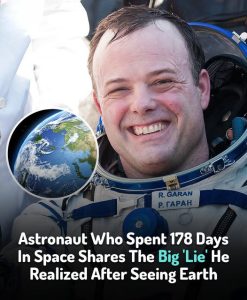
Former NASA astronaut Ron Garan, who spent 178 days in space and orbited Earth 2,842 times, has shared a profound realization about humanity’s misguided priorities. Reflecting on his experiences, Garan revealed that after seeing Earth from space, he came to the conclusion that society is “living a lie.”
Garan’s epiphany isn’t tied to conspiracy theories, but rather to something far more impactful. During an interview with Big Think, he described experiencing the ‘overview effect,’ a phenomenon common among astronauts who see Earth from space. This effect often leads to a deep emotional or spiritual awakening, as described by Apollo 14 astronaut Edgar Mitchell as an ‘explosion of awareness.’
For Garan, looking out of the spacecraft window gave him a sobering realization. “I saw the lightning storms flash like paparazzi, the auroras dancing so close they seemed touchable, and the incredibly thin layer of our planet’s atmosphere,” he recalled. That moment struck him with the stark truth that this fragile atmosphere is what sustains all life on Earth.
Rather than focusing on human-made systems, Garan saw Earth as a vibrant, iridescent biosphere teeming with life. “But the systems we’ve created treat everything, including the planet’s life-supporting systems, as mere commodities,” he said. From the vantage point of space, it became glaringly obvious: humanity has been living a lie by prioritizing the economy over the planet’s health.
This powerful experience left Garan with a sense of deep connection to everyone on Earth. “Being detached from Earth made me feel an overwhelming kinship with all people,” he shared in an interview with Forbes.
Since his return to Earth, Garan has become a passionate advocate for environmental conservation and the need to focus on planetary health rather than economic growth. He founded the Manna Energy Foundation, which provides clean drinking water to developing nations, and the Fragile Oasis project, which seeks to inspire positive global change.
As humanity continues to explore space, the lessons Garan learned may be the key to securing a sustainable future for our planet.

