In this story of corporate miscommunication and the unintended fallout of rigid, top-down policies, a retail employee shares a humorously exasperating encounter with upper management’s inflexible rules. The narrator worked at a mid-sized store known for its rotating themed “event” shelves—displays carefully curated for holidays and seasonal promotions. These setups were essential for drawing customer attention and driving sales during high-traffic times.
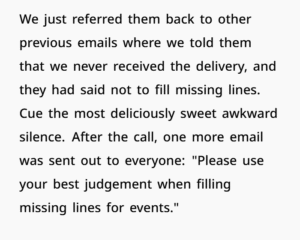
But a confusing directive from corporate disrupted this well-oiled system: if any promotional items were missing, employees were strictly instructed not to substitute or fill the empty space.
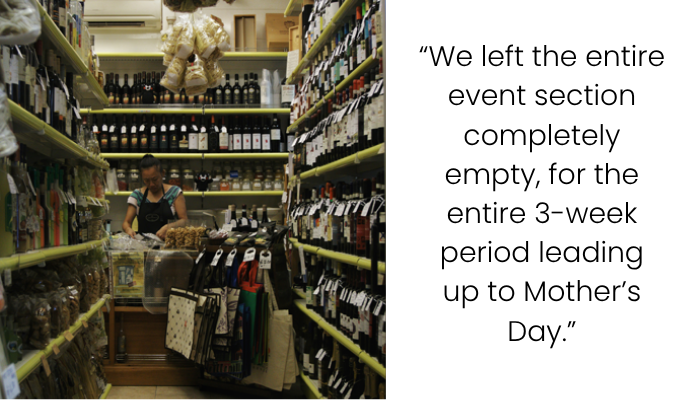
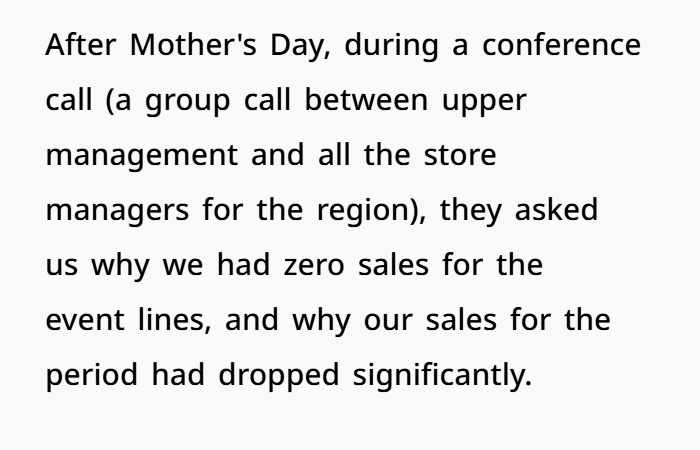
What may have sounded logical in a boardroom quickly fell apart on the sales floor. Just ahead of Mother’s Day—one of the busiest retail periods in spring—an entire shipment of promotional merchandise failed to arrive. Following orders, staff left the event shelves completely empty. For three long weeks, during peak customer traffic, the display sat bare. Unsurprisingly, sales nosedived.
When results came in, upper management was baffled by the poor performance—and promptly blamed the store team. It wasn’t until staff pointed out they were simply following corporate instructions that leadership awkwardly backtracked, eventually reversing the policy with a sheepish admission of fault.
After all, when shoppers walk in during a holiday rush, “jam-packed” is exactly how they expect those shelves to look.

At one store, however, customers were met with a display of absence—an unintended consequence of staff dutifully obeying a flawed directive.
Policy Pitfalls and the Cost of Top-Down Mismanagement
This case illustrates a textbook example of retail operations gone awry driven by the shortcomings of centralized decision-making without adequate feedback from the front lines. While large retail chains often implement uniform policies to ensure consistency across locations, these one-size-fits-all mandates can quickly become liabilities when applied without contextual flexibility.
In this instance, upper management issued a directive instructing staff to leave promotional shelves empty if specific products were unavailable apparently to simulate a “sell-out” and create a sense of urgency among shoppers. The idea may have drawn inspiration from psychological sales tactics, which suggest that perceived scarcity can elevate consumer interest.
Indeed, research in consumer behavior supports the notion: perceived scarcity can increase purchase intent but only under specific conditions. As Lynn (1991) found, the effect hinges on the assumption that the product was desirable and recently bought out. When shelves are completely bare, with no trace of what should have been there, the impression created isn’t one of popularity, but of poor planning or neglect. Rather than urgency, customers experience confusion and disappointment.
From a visual merchandising perspective, the result was equally damaging. As noted by Levy et al. in Retailing Management, empty displays are commonly interpreted as signs of mismanagement, diminishing customer trust and undermining brand credibility.
This situation also reveals a deeper failure in the supply chain communication cycle. Historically, store-level employees had the autonomy to adapt when products didn’t arrive on time by creatively filling displays with similar items or highlighting alternate promotions. That flexibility was lost under the new directive. Had staff retained that discretion, the sales impact during the crucial Mother’s Day window could have been significantly softened.
Retail management literature frequently emphasizes the value of decentralized decision-making and empowering local teams, particularly in volatile environments. As Simchi-Levi et al. argue in Designing and Managing the Supply Chain, such strategies are critical safeguards against disruptions. The eventual reversal of the empty-shelf policy by upper management though belated was an implicit acknowledgment that rigid hierarchies can magnify, rather than solve, operational challenges.