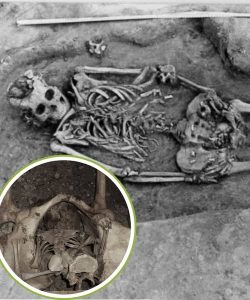
A coffin birth is an extremely rare and unsettling phenomenon where a deceased pregnant woman appears to give birth after death. Scientifically referred to as postmortem fetal extrusion, this event occurs when gases from natural decomposition build up in the body and force the fetus out of the birth canal.
Although it’s incredibly rare today due to modern embalming and cremation practices, coffin births have occurred throughout history and continue to be documented in very uncommon cases.
How Does a Coffin Birth Happen?
After death, the human body begins to break down through a process called putrefaction. Bacteria in the digestive system multiply rapidly, releasing gases like carbon dioxide, methane, and hydrogen sulfide. As these gases accumulate, they cause the body to bloat. In some cases, the pressure becomes so intense that it pushes the uterus downward, leading to the expulsion of the fetus through the vaginal canal.
This typically happens within 48 to 72 hours after death and almost always results in the expulsion of a nonviable fetus.
Historical Accounts of Coffin Births
There are a few documented historical cases of coffin births, although many details remain unclear due to the passage of time.
In 1551, during the Spanish Inquisition, a pregnant woman was executed. Witnesses reported that two deceased infants fell from her body hours after her death, likely due to the rapid onset of decomposition.
In 1650, a woman named Emme Toplace was said to have given birth shortly after burial. Reports claim that witnesses heard sounds coming from her grave, and a living baby was recovered. While dramatic, this account may point more to a premature burial than a true coffin birth.
Archaeologists in Imola, Italy, discovered a medieval grave in 2010 where a fetus had partially emerged postmortem from the body of a woman buried in the 7th or 8th century.
Medical texts such as Anomalies and Curiosities of Medicine from 1896 record a few more of these events, but all confirm that even centuries ago, such occurrences were very rare.
Modern-Day Cases
Despite medical advancements, there are a few modern examples that prove coffin births can still happen:
In 2005, a pregnant woman in Germany died from a heroin overdose. When her body was found, her deceased fetus had partially emerged from her birth canal.
In 2008, a woman in Panama who was seven months pregnant was found murdered. Investigators later determined that her body had expelled the fetus after death.
In 2018, when Shanann Watts was found buried in a shallow grave after being murdered by her husband, an autopsy revealed that her body had expelled her 15-week-old fetus, a baby boy named Nico.
In all of these cases, the fetus did not survive, and the incidents were discovered during forensic investigations.
Why Are Coffin Births So Rare Today?
Thanks to advances in medical science and funeral practices, coffin births are almost unheard of today. Embalming halts the decomposition process, and cremation eliminates the possibility entirely. Additionally, improved understanding of maternal health and death prevention has reduced the number of such tragedies.
Still, for forensic experts and medical historians, coffin births offer a sobering look at what happens when life ends abruptly, and how the human body responds in death.
While they remain disturbing and tragic, these cases also highlight the powerful biological processes that continue even after life has ended.